
Primefit CR1401G
4.5Editor score
Accurate regulation between one and 150 PSI
Steel protected gauge for durability
Sixty SCFM flow rate at 100 PSI
Finding the right air pressure regulator is essential for maintaining consistent tool performance and ensuring safety in any workshop environment. A good unit stabilizes compressed air lines to deliver precise downstream setpoints that protect delicate equipment from pressure spikes and fluctuations.
We evaluated ten top-rated models based on flow capacity, construction material, gauge accuracy, and adjustment mechanisms. Each product was assessed for its ability to handle varying demands while maintaining steady output across different pressure ranges and thread sizes.
Every pick includes detailed specs, pros, cons, and real-world application notes to help you choose the correct fit for your compressor setup. Please note that pricing and availability can change frequently, so verify current details before making your final purchase decision.
4.5Editor score

4.5Editor score

4.3Editor score
As an Amazon Associate we earn from qualifying purchases.
The following table provides a side-by-side comparison of all ten models, highlighting key specifications such as thread size, flow rate, pressure range, and material construction to help you quickly identify the best fit for your needs.


The PneumaticPlus SAR200-N02BG stands out as the top choice for general-purpose shop and production lines. With a 4.5 star rating, it delivers precise downstream setpoints that are critical for sensitive pneumatic machinery and spray equipment. Its relieving design ensures safety by venting excess pressure automatically whenever it rises above your setpoint.
We may earn a commission when you buy through this link, at no additional cost to you.
Key strengths include the 39 SCFM flow rate at 90 PSI, which supports consistent volume for most tools without bottlenecks. The fully adjustable 0 to 150 PSI range lets you match exact working pressures for different processes. The locking knob prevents accidental shifts on busy shop floors, maintaining calibration over time.
Trade-offs involve its size, which may require more space than compact models, and the 1/4 NPT ports might not suit high-flow industrial headers. These are acceptable given the precision and durability it offers. The ISO 6953 compliance signals adherence to professional standards for compressed air regulation.
Anyone needing reliable performance for air tools, actuators, and spray guns should buy this regulator. It balances affordability with industrial-grade features that protect your investment. Verify current stock before ordering as demand for quality pneumatic parts often runs high.
The inline body installs quickly into shop lines and holds set pressure steady even as air demand fluctuates.
Excess downstream pressure is vented automatically to protect tools and delicate equipment from damage spikes.
We may earn a commission when you buy through this link, at no additional cost to you.
The Primefit CR1401G offers exceptional value for users seeking reliable pressure control without a high price tag. With a 4.5 star rating, it maintains constant air pressure between 1 and 150 PSI, making it suitable for inflating tires, operating air tools, and small workshop applications.
We may earn a commission when you buy through this link, at no additional cost to you.
Its 60 SCFM flow at 100 PSI ensures sufficient volume for moderate-demand tasks. The steel-protected gauge adds durability against bumps and drops that often occur in busy environments. The composite knob is impact resistant, reducing the risk of damage during frequent adjustments.
One limitation is the strict directional flow requirement from right to left when configured with the knob on top. Misconfiguration will cause failure, so careful attention is needed. However, it can be flipped for left-to-right flow if installed correctly, offering some flexibility.
Budget-conscious shoppers or hobbyists needing a straightforward regulator should choose this model. It provides the essential features needed for stable operation without unnecessary complexity. Ensure you set the flow direction correctly before tightening connections to avoid leaks or malfunction.
The steel protection around the gauge helps it withstand typical workshop hazards that might damage standard plastic cases.
Once set, the regulator maintains constant downstream pressure to ensure consistent performance from your pneumatic tools.
We may earn a commission when you buy through this link, at no additional cost to you.
The Milton 1114-8 is built for heavy industrial duty where flow and reliability are paramount. Its 4.3 star rating reflects steady performance in demanding settings. With 80 SCFM at 100 PSI, it handles larger systems without restriction, ensuring tools operate at full capacity.
We may earn a commission when you buy through this link, at no additional cost to you.
Made in the USA, this regulator benefits from tighter manufacturing tolerances and quality control. The operating temperature range from 40 to 120 degrees Fahrenheit allows use in varied climates without performance loss. The 3/8 NPT threads accommodate higher flow connections common in industrial headers.
The main trade-off is the cost, which is higher than standard shop models. This is justified by the durability and flow capacity for serious applications. The size is also larger, which requires adequate mounting space near the compressor or tool station.
For industrial environments or high-demand workshop setups, this is the premium choice. It minimizes downtime caused by regulator failure under stress. Confirm the thread size matches your line before purchasing to ensure proper connection and optimal performance.
Eighty SCFM ensures large tools and multiple outlets receive sufficient air volume without pressure drops during heavy use.
Domestic manufacturing often means better quality control and materials for long-term reliability in tough conditions.
We may earn a commission when you buy through this link, at no additional cost to you.
The SNS regulator provides a straightforward solution for basic shop needs with a 4.2 star rating. It includes a mounting bracket and gauge, reducing the need for extra parts. The aluminum body keeps weight down, making it easy to mount in tight spaces.
We may earn a commission when you buy through this link, at no additional cost to you.
Adjustments are made via a rotary knob that requires a pull-up action before rotating. Clockwise increases pressure while anticlockwise decreases it. This simple mechanism works well for occasional adjustments, though it lacks a locking feature found in higher-end models.
Flow capacity is limited to 19.4 SCFM, which suits small tools but may not support high-demand equipment. The lack of a locking knob means settings could shift with vibration over time. These trade-offs are acceptable for light-duty hobbyist use.
Users needing a basic regulator for inflators and small tools will appreciate its simplicity and completeness. Check that the flow meets your tool requirements before buying to ensure adequate performance. Install in a vibration-free zone to maintain stable settings.
Bracket and gauge are included, saving you time and money on sourcing extra accessories for your setup.
The lightweight aluminum body fits well in compact spaces where larger regulators would not fit.
We may earn a commission when you buy through this link, at no additional cost to you.
This heavy-duty unit supports high-flow applications with a 4.5 star rating. The 3/4 NPT threads and 140 SCFM rate make it ideal for systems with multiple tools or high-demand machinery. The pressure range from 7 to 215 PSI covers most industrial requirements.
We may earn a commission when you buy through this link, at no additional cost to you.
A high impact locking composite knob prevents accidental changes. This is critical in busy workshops where settings might otherwise shift. The gauge and wall bracket allow ready installation without extra sourcing. The output is capped at 215 PSI to match typical compressor capacities.
The unit is physically large and heavier than standard shop models. This impacts mounting options and space planning. The price reflects the heavy-duty build and high capacity. Ensure your compressor can supply the needed volume before selecting this model.
For professional shops or industrial setups needing high volume, this is a strong candidate. Verify the thread and pressure match your system to avoid compatibility issues. Install securely to prevent stress on connections during operation.
One hundred forty SCFM keeps large tools running at peak efficiency without pressure loss under heavy load.
The locking knob holds settings firmly even when equipment vibrates during operation to maintain accuracy.
We may earn a commission when you buy through this link, at no additional cost to you.
Ingersoll Rand is a well-known name in pneumatic tools, reflected in this regulator's 4.3 star rating. The 59 CFM flow at 90 PSI supports medium tasks effectively. A flush-mount gauge provides a clean appearance and better protection than protruding types.
We may earn a commission when you buy through this link, at no additional cost to you.
The standard knob control allows easy adjustment without extra steps. The relieving design protects downstream equipment from over-pressure situations. The 0 to 140 PSI range is sufficient for most general shop tools but may be low for higher pressure requirements.
One consideration is the lack of a mounting bracket, which may require a purchase if wall mounting is desired. The max pressure is lower than some heavy-duty alternatives. These are minor drawbacks given the brand reliability and performance for standard applications.
Users valuing brand trust and standard shop flow will find this a solid choice. Ensure your compressor pressure matches the regulator's max range to prevent damage. Install according to best practices for reliable long-term performance.
Ingersoll Rand is a recognized name in pneumatics, suggesting dependable quality and support from the manufacturer.
The gauge sits flush with the body for a streamlined look and reduced risk of accidental damage.
We may earn a commission when you buy through this link, at no additional cost to you.
The LEMATEC unit focuses on finish quality with a 4.4 star rating. The solid brass body ensures durability and consistent flow. It helps minimize overspray and waste by enabling precise air volume control at the tool, ideal for automotive or detailed painting.
We may earn a commission when you buy through this link, at no additional cost to you.
The integrated 0 to 150 PSI gauge allows accurate monitoring and fine-tuning. The universal 1/4 NPT fit connects easily to hoses or spray guns. The responsive knob permits quick on-the-fly changes for different materials or projects.
It is optimized for spray applications rather than high-flow industrial tools. Brass construction is heavier but offers longevity. If you need high volume for large tools, consider a regulator with higher SCFM ratings. For finishing work, this delivers excellent control.
Painters and finishers looking to improve application quality should choose this model. Verify the gauge range meets your spray gun requirements before purchasing. Install close to the tool to get best response and consistent results.
Fine control over air flow reduces overspray and material waste for a smoother, more even application.
A solid brass body resists corrosion and wear, ensuring reliable operation over long periods of use.
We may earn a commission when you buy through this link, at no additional cost to you.
This Primefit model serves as a reliable replacement for worn regulators in existing setups. It shares the same design as entry #2, offering consistent pressure between 1 and 150 PSI. The steel protected gauge resists damage during routine handling.
We may earn a commission when you buy through this link, at no additional cost to you.
With 60 SCFM at 100 PSI, it supports moderate flow needs. The composite knob is impact resistant and easy to operate. The one-way flow must be set correctly for proper function. If configured correctly, it delivers steady downstream pressure.
Trade-offs include limited flow compared to larger industrial units and the need to observe flow direction. The brand may lack recognition but performance holds steady. It is an economical choice for shops replacing old units without upgrading capacity.
Shops looking for a cost-effective swap should consider this option. Check the flow direction arrows during installation. Ensure the pressure matches your line requirements to maintain stable tool performance after replacement.
Offers reliable performance at a low cost for replacing worn regulators without needing a full system upgrade.
The steel protection on the gauge helps it withstand impacts and keeps readings clear over time.
We may earn a commission when you buy through this link, at no additional cost to you.
This 3/4 inch regulator supports higher pressure systems with a 4.4 star rating. It regulates from 7 to 225 PSI, covering most compressor outputs. The directional flow arrows and IN/OUT markings make correct installation straightforward to avoid failure.
We may earn a commission when you buy through this link, at no additional cost to you.
The pull-to-unlock knob adjusts pressure easily and presses in to lock. Two 1/4 inch gauge ports allow flexibility in mounting the gauge on either side. The included bracket simplifies wall mounting. Max pressure of 225 PSI aligns with typical industrial needs.
It requires careful attention to flow direction to work properly. The size is larger, which impacts space planning. The two gauge ports offer options but may require a plug if unused. These are acceptable for the pressure range and features.
Systems needing high pressure and large thread sizes should choose this model. Ensure connections use the correct NPT threads to prevent leaks. Verify the gauge is installed on a side with proper access to readings.
Up to 225 PSI output supports high-pressure equipment that standard shop regulators cannot handle safely.
Marked IN and OUT ports with flow arrows ensure you connect the unit correctly to avoid damage.
We may earn a commission when you buy through this link, at no additional cost to you.
This 1/2 inch regulator provides a balance between flow and pressure with a 4.4 star rating. It handles up to 225 PSI output and fits systems needing larger connections than 1/4 inch but less than 3/4 inch. The aluminum body ensures durability.
We may earn a commission when you buy through this link, at no additional cost to you.
The pull-to-unlock knob allows easy adjustments that lock in place. Two 1/4 inch gauge ports permit flexible placement for visibility. Clear IN and OUT markings help avoid installation errors. Supports temperatures up to 140 F for warm environments.
Orientation must be correct for flow direction to work. The cost is higher than smaller regulators but justified by the flow and pressure capacity. For many commercial systems, this size offers the right compromise between performance and footprint.
Commercial users needing moderate flow and high pressure should consider this unit. Ensure threads match your lines before purchase. Install where gauge readings are easy to monitor during operation for best results.
One-half inch threads suit mid-sized lines well, offering more flow than 1/4 without bulk of larger units.
Supports up to 140 degrees Fahrenheit, making it suitable for warm shop floors or outdoor enclosures.
We may earn a commission when you buy through this link, at no additional cost to you.
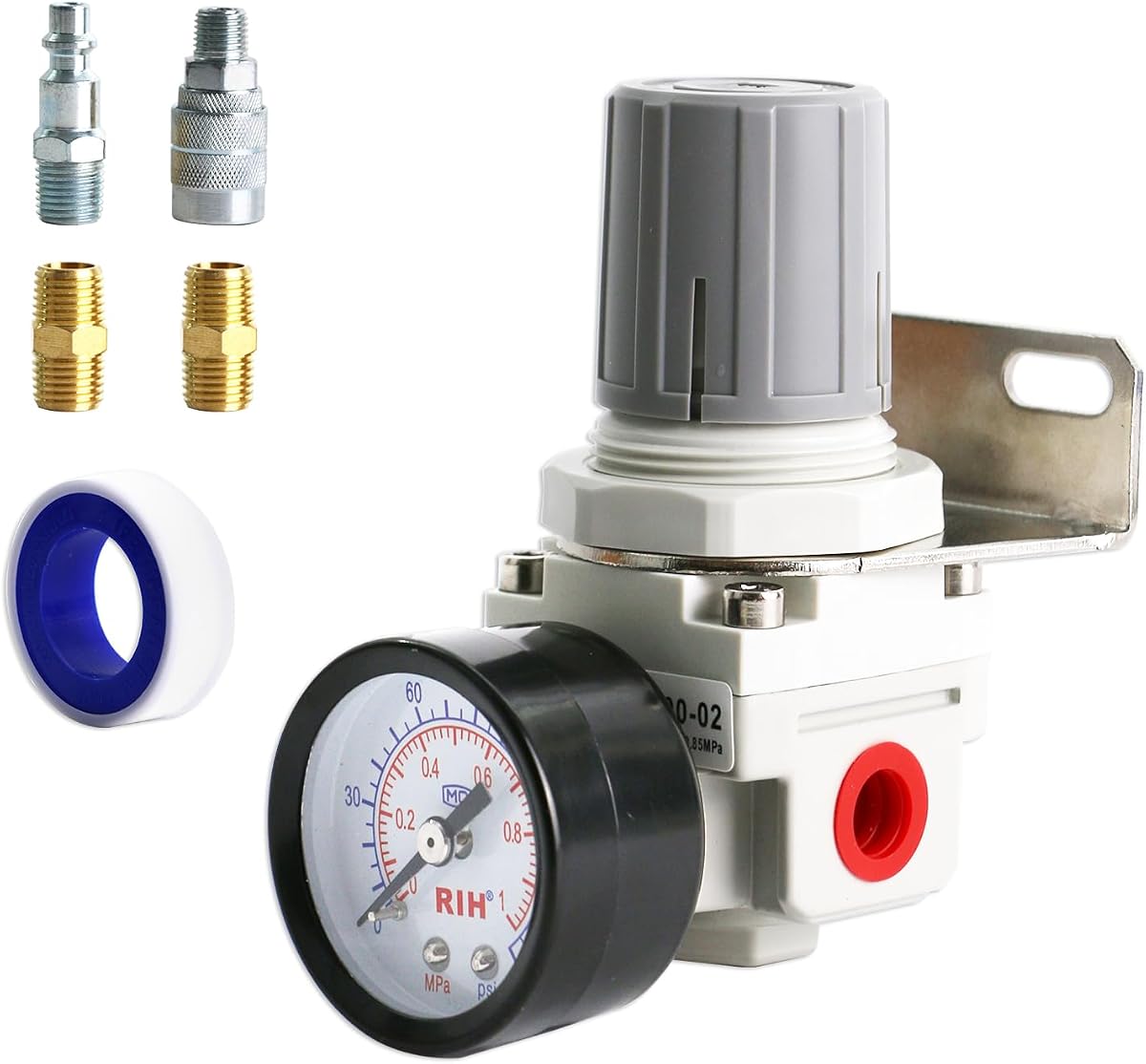
The RIH model offers a complete kit at an attractive price, reflected in its 4.7 star rating. It includes a gauge, couplers, plug kit, and thread seal tape, making it ready to install. The aluminum body is lightweight and corrosion resistant.
We may earn a commission when you buy through this link, at no additional cost to you.
It regulates from 0 to 145 PSI with 20 SCFM flow at 90 PSI. The pull-up knob rotates clockwise to increase pressure and anticlockwise to decrease. PTFE tape is included to prevent leaks at joints. Two 1/4 NPT fittings ease connection.
Flow is lower than some competitors, which limits high-demand applications. Max pressure is capped at 145 PSI, which is lower than 150 PSI units. For basic needs, the complete kit and high user rating make it a strong contender.
Shops seeking a ready-to-use set should choose this model. Ensure flow needs are met before purchasing. Apply extra tape turns if leaks occur at joints as recommended by the manufacturer for best seal integrity.
Includes couplers, tape, and fittings, so you can set up without buying extra accessories.
The knob instructions specify rotation directions for quick setup and accurate pressure changes.
We may earn a commission when you buy through this link, at no additional cost to you.
Selecting the right regulator requires balancing flow, pressure, and build quality to match your tools and system layout.
Flow rate, measured in SCFM or CFM, dictates how much air volume your regulator can pass. If your tools draw more air than the regulator's capacity, pressure will drop under load causing poor performance. Always choose a unit with a flow rating higher than your total tool demand to ensure consistent output.
Check the manufacturer's flow curve to see how pressure holds at different CFM levels. A higher rating provides a safety margin when you add more tools or run large equipment.
Regulators have specific input and output pressure limits. Confirm that your compressor's max pressure matches the regulator's input rating to avoid damage. The output range must cover the working PSI required by your tools. Some models cap at 140 PSI, others go to 225 PSI, so match this to your needs.
Avoid units with a narrow range if you need to switch between low and high-pressure tools. A broader range offers more versatility across different applications.
Thread size like 1/4 NPT or 3/4 NPT determines how the regulator connects to your lines. Smaller threads are common for single tools while larger threads support high-flow headers. Using the wrong size can cause leaks or limit air delivery, so match your existing fittings.
Ensure both inlet and outlet threads match your hose and tool connections. Use Teflon tape on threads to prevent air leaks and ensure a secure seal.
Materials like aluminum, brass, and composite impact durability and weight. Aluminum is light and corrosion resistant for shop use. Brass is heavier but ideal for environments where chemical resistance is key. Composite knobs reduce breakage risk in busy workshops.
Look for solid metal bodies for industrial use and lighter alloys for portable setups. Corrosion resistance matters in humid environments to extend service life.
A clear gauge helps you monitor pressure in real time. Some gauges are recessed or steel protected to resist damage. Accuracy matters for precise applications like painting where small PSI changes affect finish quality.
Choose units with easily readable dials. If the gauge is exposed to impacts, a protective ring or shield is valuable.
Look for knobs that adjust easily and lock firmly to prevent drift. Some units require pulling up before rotation. Locking features hold settings under vibration. Avoid knobs that feel loose or strip easily during use.
The mechanism should feel responsive. A good knob allows precise turns and holds the set position without slipping.
Wall brackets or panel mounts simplify installation near compressors or tool benches. Some models include brackets while others do not. Verify what is needed before ordering to avoid extra costs.
Mounting should keep the unit stable and reduce stress on hoses. A secure mount ensures consistent performance over time.
Manufacturers offer varying warranty terms, often one year for basic models. A longer warranty signals confidence in durability. Responsive support helps if parts fail or installation questions arise.
Consider brands with strong reputations for service. Having access to support can save downtime if issues occur.
Begin by installing the unit with correct flow direction as marked on the body. Use thread seal tape on all NPT connections and tighten snugly to prevent leaks. Mount the regulator on a stable bracket or panel to avoid vibration loosening fittings.
Set the desired pressure by pulling the adjustment knob and rotating clockwise to increase or counterclockwise to decrease. Release the knob to lock the setting. Check the gauge to confirm the reading and make small adjustments as needed for your specific tool.
Inspect the regulator periodically for leaks, damage, or gauge drift. Clean the body with a dry cloth and ensure the knob operates smoothly. If pressure settings drift frequently, check the seal or consider replacing worn parts to maintain consistent operation.
A regulator controls and reduces air pressure to a set level while a filter removes moisture and contaminants from the air. Some units combine both functions in one housing. It is common to place a filter upstream from the regulator to protect it from debris.
Check the tool's manual or the label on the body for its required PSI. Most pneumatic tools work best around 90 PSI but some need higher or lower. Setting the regulator to this level ensures performance without damage.
Yes, small regulators work well for inflators and tire inflation. Ensure the flow meets your needs and the gauge is accurate. A regulator helps prevent over-inflation by giving precise control over the air delivery.
Pressure drops can occur if the regulator flow rating is too low for the tool demand. Check if your compressor supply is sufficient and that connections are not restricted. Upgrading to a higher flow unit often fixes this.
A relieving regulator vents downstream air when pressure drops below the setpoint to protect equipment. This prevents pressure buildup that could damage tools. Most modern regulators include this feature by design.
A quality regulator can last for years with proper care and normal shop use. Life depends on frequency of use and environmental conditions. Regular inspection and cleaning help extend the service life significantly.
It is best to have a regulator on each outlet or tool line. This lets you set specific pressures for different tools. A main regulator on the tank helps but individual regulators give better control for each task.
One-quarter inch NPT is the most common size for small shops and tools. Larger systems may use three-eighths or one-half inch. Match your existing fittings and ensure threads are compatible to avoid leaks.
The top picks in this guide highlight the best options for different needs ranging from budget-friendly models to heavy industrial units. The PneumaticPlus and Primefit options offer reliable performance for general use while the Milton model supports high-demand applications.
Prioritize flow rate, thread size, and pressure range to ensure the unit fits your setup. Build quality and gauge accuracy are critical for consistent results and equipment safety. Consider mounting needs and warranty support as well.
Prices and availability may shift, so check current listings before ordering. A small investment in a reliable regulator protects your tools and improves project outcomes. Choose wisely based on your specific requirements for the best long-term value.