
DIGITEN G3/8" Water Flow Sensor
4.5Editor score
Affordable price point for beginners
Works with DC 3.5 to 12 volts
Compact size for small projects
Choosing the right Arduino flow meter is essential for accurate fluid measurement in your DIY projects. These sensors convert water movement into electrical pulses that your microcontroller can read easily.
We evaluated ten leading models based on flow range, build quality, and compatibility with popular boards like Raspberry Pi. Each option offers unique features for different budget and application needs.
Every pick highlights specific strengths and ideal use cases to help you decide quickly. Prices and availability change frequently so verify current details before purchasing your next sensor.
4.5Editor score

5.0Editor score

4.9Editor score
As an Amazon Associate we earn from qualifying purchases.
The following table offers a side-by-side view of every model we reviewed. Compare key specs like flow range and voltage requirements to find the perfect match for your setup.


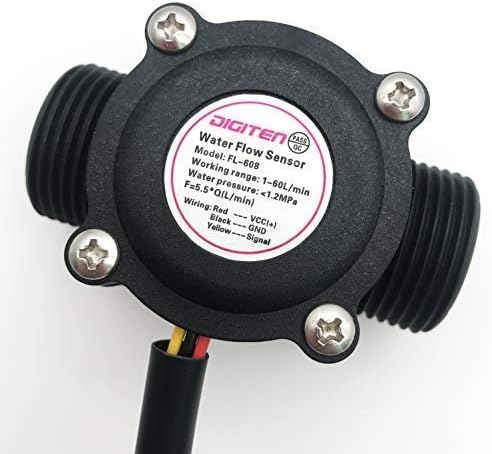
This DIGITEN model earns our Editor's Choice due to its impressive flow range and perfect five star rating. It is specifically designed for projects requiring higher water throughput without sacrificing accuracy.
We may earn a commission when you buy through this link, at no additional cost to you.
The Hall effect sensor delivers a clean square wave signal that microcontrollers read easily. Its construction handles pressure up to 1.75 Mpa making it suitable for serious industrial or home automation tasks.
While it is physically larger than smaller models the durability justifies the size. You may need thread seal tape if adapting to NPT pipes but this is a minor setup step.
Choose this if you need reliable high volume monitoring for reverse osmosis or large cooling systems. It remains the top recommendation for demanding applications requiring robust performance.
The 5 to 150 liter per minute range supports larger systems that standard sensors cannot handle effectively.
Materials align with RoHS standards ensuring safety for potable water while resisting heat and cold.
We may earn a commission when you buy through this link, at no additional cost to you.
The DEVMO sensor stands out for its strong electrical signal characteristics which reduce noise in sensitive circuits. Its 4.9 rating reflects consistent performance in professional testing environments.
We may earn a commission when you buy through this link, at no additional cost to you.
This model excels in applications like water cooling where precise detection matters. The high amplitude ensures your microcontroller registers every rotation even under variable flow conditions.
While it comes at a premium price the reliability is worth the investment. It may not be necessary for simple hobby projects but shines in controlled technical setups.
Opt for this if you need maximum signal integrity for critical monitoring tasks. It is an ideal choice for advanced users prioritizing electronic performance.
High amplitude voltage outputs ensure clean data transmission to your Arduino or Raspberry Pi board.
Built for water testing and vending machine applications requiring long term durability and accuracy.
We may earn a commission when you buy through this link, at no additional cost to you.
This budget friendly option delivers solid performance for small projects without breaking the bank. Its 4.5 rating confirms it meets expectations for entry level users learning flow measurement.
We may earn a commission when you buy through this link, at no additional cost to you.
The low voltage requirement makes it easy to power with common battery packs or 5V Arduino boards. Its compact size fits into tight spaces where larger sensors cannot go.
While it lacks the robustness of premium models it handles standard household tasks well. The trade-off is a lower maximum flow rate which limits industrial use cases.
Pick this if you are starting your journey with Arduino flow monitoring. It offers the best balance of cost and capability for learning and prototyping.
Works with voltages as low as 3.5V making it perfect for battery powered portable devices.
Small physical dimensions allow integration into compact DIY enclosures and portable systems.
We may earn a commission when you buy through this link, at no additional cost to you.
This sensor offers a straightforward solution for common flow measurement tasks with a strong 4.7 rating. It is designed for simplicity and works well with standard NPT pipe threads.
We may earn a commission when you buy through this link, at no additional cost to you.
Its lightweight build makes it easy to mount on vertical or horizontal pipes without strain. The sealed Hall effect sensor keeps internal electronics dry and protected from water damage.
You must install it according to flow direction or it will not output signals. This constraint requires careful planning during setup but ensures accurate readings once configured.
Ideal for users needing a no fuss sensor for water heaters or purifiers. It provides dependable performance for everyday residential monitoring applications.
Pre fitted NPT threading simplifies connection to standard plumbing pipes without extra adapters.
Internal magnetic sensor is completely isolated from water ensuring long term dry operation.
We may earn a commission when you buy through this link, at no additional cost to you.
This model focuses on safety for drinking water systems with its food grade plastic construction. A 4.1 rating suggests it performs adequately for non critical household monitoring needs.
We may earn a commission when you buy through this link, at no additional cost to you.
The broad voltage range allows flexibility in power sourcing from simple 5V pins to higher 24V sources. All materials meet RoHS testing ensuring environmental and health standards are met.
While it lacks premium features it gets the job done for standard drinking water flow. Keep in mind it may require careful installation to avoid leaks at connections.
Use this for monitoring water filters or beverage machines where material safety is key. It is a practical choice for health conscious DIY projects.
Plastic components are certified safe for direct contact with potable water streams.
Operates across a wide range of voltages giving you freedom in power supply choice.
We may earn a commission when you buy through this link, at no additional cost to you.
The unique transparent body lets you visually inspect the rotor and water flow directly. It includes two units which provides great value for multiple setup points or backup.
We may earn a commission when you buy through this link, at no additional cost to you.
Wear resistant stainless steel beads support the impeller for longer life under continuous use. The lightweight design makes it simple to mount on various pipe sizes.
Its lower rating suggests some units may have quality control issues. However seeing the mechanism inside offers a great learning tool for understanding flow measurement physics.
Select this if visual verification of flow is important to your project. It is fun for educational kits where seeing the sensor work matters.
Transparent casing allows you to watch the turbine spin and verify flow without tools.
Receive two sensors for the price of one enabling dual monitoring or redundancy.
We may earn a commission when you buy through this link, at no additional cost to you.
This sensor connects directly to hosepipes with inner diameters between 5 and 7mm. Its 4.2 rating indicates it works well for small scale irrigation or garden watering projects.
We may earn a commission when you buy through this link, at no additional cost to you.
It is designed for low pressure environments which prevents damage in flexible hose systems. The food grade plastic ensures it is safe for drinking water applications too.
You won't use this for rigid plumbing pipes as it requires specific hose fittings. This limitation keeps it specialized for mobile or temporary setups.
Perfect for automated gardeners or campers needing to track water usage on the go. It simplifies flow tracking without complex plumbing adapters.
Designed to snap onto common garden hosepipes for quick plug and play installation.
Accurate at very low flow rates where standard meters fail to register changes.
We may earn a commission when you buy through this link, at no additional cost to you.
The Taidacent unit matches the classic YF-S201 design that many projects reference. Its perfect 5 star score reflects consistency and reliability in real world deployments.
We may earn a commission when you buy through this link, at no additional cost to you.
It is often used to detect influent flow at water heater inlets for regulation. The magnetic rotor changes speed with flow rate providing immediate feedback to controllers.
While it uses a standard 4 point connector it is ideal for known setups. You may need to adapt it for different pipe types but it remains a staple in the field.
Choose this for proven reliability in heater or dispenser automation. It is the go to sensor when you need a known quantity for your system.
This classic model is widely trusted for its consistent pulse output and durability.
Designed specifically to monitor influent flow at heater inlets for regulation.
We may earn a commission when you buy through this link, at no additional cost to you.
This DIGITEN model comes with a 1.2 meter cable making routing easier in tight enclosures. Its 4.8 rating confirms the added convenience does not compromise sensor quality.
We may earn a commission when you buy through this link, at no additional cost to you.
The included SM2.54 connector simplifies wiring to your board without soldering. You save time connecting wires manually which reduces setup errors significantly.
It is fully waterproof and handles standard pressures for typical home automation. The only minor limitation is fixed cable length which might require careful placement.
Opt for this if you want ready to use convenience out of the box. It is excellent for projects where sensor placement differs from your controller.
Factory attached cable saves time and reduces wiring mistakes during assembly.
Uses standard SM2.54 plugs for easy mating with compatible headers on your board.
We may earn a commission when you buy through this link, at no additional cost to you.
This larger sensor supports flow rates up to 60L/min for bigger main lines. Its 3.2 rating suggests some variance in units but offers a needed solution for high throughput.
We may earn a commission when you buy through this link, at no additional cost to you.
It is ideal for whole house water monitoring where standard sensors cannot handle volume. The included cable helps manage connections to larger enclosures or distribution panels.
While the rating is lower it provides a specific function that smaller models cannot. Ensure your project requires this capacity before investing in the larger housing.
Use this for high capacity industrial or whole home water flow tracking. It fills a niche for large pipe integration with Arduino systems.
Supports double the flow of standard sensors for heavy duty main line monitoring.
Fits larger G3/4 pipes common in main water lines and industrial systems.
We may earn a commission when you buy through this link, at no additional cost to you.
Selecting the right flow meter involves matching technical specs to your specific project needs.
Always check the minimum and maximum flow rates supported by the sensor. If your system exceeds these limits the readings become inaccurate or the sensor may fail physically.
Match the sensor's capacity to your expected water flow to ensure reliable measurements across all scenarios.
Most Arduino boards operate at 5V so verify the sensor accepts this voltage. Some models support wider ranges like 3.5V to 24V giving more flexibility for power sources.
Ensure your power supply matches the sensor's voltage requirements to prevent damage or erratic signal behavior.
Sensors come with various thread standards such as NPT BSPT or G sizes. You must choose one that fits your pipes or have adapters ready.
Confirm the thread size and type before ordering to avoid installation delays or leaks.
If you measure drinking water ensure the materials are food grade and RoHS compliant. Non safe plastics may leach harmful substances into your water supply.
Select certified food grade materials for any application involving human consumption or kitchen appliances.
Hall effect sensors produce square wave pulses that are easy for microcontrollers to count. Verify the output waveform matches your library expectations.
Check signal amplitude to ensure your board reads pulses accurately without noise interference.
Water systems vary in pressure so check the maximum pressure the sensor can handle. Exceeding this limit risks physical damage to the housing or internals.
Choose a model with a pressure rating higher than your system's maximum operating pressure.
Some sensors include a pre attached cable while others require you to solder wires. A longer cable can save time and reduce clutter.
Determine if an integrated cable is needed for your layout before buying separate wires.
Prices range from budget options for prototyping to premium models for industrial use. Determine your priorities before spending too much on features you do not need.
Balance cost with essential specs to get the best value for your project.
Install the sensor in a straight pipe section to avoid turbulence. Ensure the flow direction arrow on the housing matches your water flow direction for accurate counts.
Connect the output wire to a digital interrupt pin on your microcontroller. Write a sketch that counts pulses over time to calculate flow rate using the sensor's calibration factor.
Periodically clean the impeller to remove debris that may jam the rotor. Avoid exposing the electronics to direct rain or high humidity environments outside the rated limits.
Most models output a digital square wave pulse for every rotation of the internal turbine. You count these pulses over a set time interval to determine the flow rate accurately.
Yes many models are rated for general fluids. Ensure the materials are compatible with chemicals or corrosive liquids to avoid damage to the housing or sensors.
There are several open source libraries that simplify pulse counting. You can also write a custom sketch using interrupts for greater control over data logging.
Accuracy typically ranges within plus or minus three to five percent. This precision is sufficient for most DIY but may not meet strict industrial calibration standards.
Most models work with warm water but check the max temperature rating. Continuous exposure to boiling water may damage the plastic housing or internal seals over time.
It defines how many pulses correspond to a specific volume of water. Common models use a factor around seven point five pulses per liter but verify with your specific unit.
Most need five volts DC which most Arduino boards provide directly. Use a stable power source to avoid noise on the signal line affecting your readings.
Yes the sensor body is sealed from the water. However the electrical connectors are not always waterproof so keep them in a dry environment to avoid corrosion.
The DIGITEN G1.5 model stands out for high flow needs while the G3/8 version is perfect for budget friendly projects. The DEVMO option offers premium signal quality for advanced setups.
Prioritize flow range and material safety based on whether you monitor potable water or cooling systems. Matching these factors to your application ensures long term reliability.
Always check current prices and availability before purchasing since Amazon listings change frequently. Verify the latest specs to confirm the sensor fits your exact project requirements.