
HiLetgo ESP8266 ESP-01
4.2Editor score
Compact and lightweight design
Supports AP, STA, and AP+STA modes
Low-cost wireless transceiver solution
This guide compares the top Arduino WiFi modules for connectivity including the UNO R4, ESP8266, and ESP32 boards for reliable IoT and embedded projects.
Selecting the right Arduino WiFi module is essential for building connected devices that communicate reliably. Whether you need simple sensor data transmission or complex edge AI, the right board simplifies development and ensures stable performance in your projects.
We evaluated ten top modules based on connectivity, processing power, ease of use, and community support. Our comparison covers standalone transceivers and full development boards to help you find the perfect fit for your specific application needs.
Each pick highlights key strengths, real-world performance, and ideal use cases to guide your decision. Prices and availability may change, so check current listings before purchasing to ensure you get the best value for your investment.
4.2Editor score

4.7Editor score

4.7Editor score
This side-by-side comparison highlights the unique strengths of each module, helping you choose based on performance, connectivity options, and ease of integration.



The Arduino UNO R4 WiFi stands out as a top-tier development board for advanced IoT projects. With a 4.7 rating from users, it delivers robust performance through its dual-core design and modern connectivity features. Its standout qualities include an integrated LED matrix and versatile wireless options that simplify complex applications.
We may earn a commission when you buy through this link, at no additional cost to you.
Its dual-core architecture combines a Renesas RA4M1 for real-time processing and an ESP32-S3 for wireless tasks. This allows high-speed communication, cloud integration, and even edge AI applications. The 12-bit DAC and OP-AMP enable precise analog control, while the USB-C port ensures reliable power and programming.
While it offers premium features, the board requires a higher investment than basic modules. Its larger size may limit compact projects. However, the added functionality, easier wiring, and enhanced performance make these trade-offs worthwhile for serious developers.
Advanced makers building smart sensors, robotics, or industrial systems will appreciate its capabilities. If you need powerful processing and reliable wireless control, this board is the ideal choice for your next innovation.
The Qwiic connector and USB-C port simplify wiring and power, reducing setup time.
The built-in LED matrix lets you display data directly on the board without external screens.
We may earn a commission when you buy through this link, at no additional cost to you.
The HiLetgo ESP8266 ESP-01 is a budget-friendly module perfect for beginners and small projects. Rated 4.2 by users, it offers reliable wireless connectivity at a very low cost. Its compact design allows easy integration into tight spaces where larger boards won't fit.
We may earn a commission when you buy through this link, at no additional cost to you.
It includes powerful onboard processing and supports three modes: AP, STA, and AP+STA. This flexibility makes it suitable for smart grids, home automation, and sensor networks. While it requires external 3.3V power and some soldering, it delivers solid performance for the price.
The main drawbacks are the need for external voltage regulation and manual wiring. Beginners may find the setup slightly tricky compared to plug-and-play boards. However, the affordability and versatility make it a great choice for prototyping and small-scale IoT applications.
Anyone looking for an affordable entry point into WiFi-enabled Arduino projects will find this module ideal. If budget is your priority and you need basic connectivity, this ESP8266 module delivers excellent value.
At a very low price point, this module provides essential wireless features without breaking the bank.
Support for AP and STA modes allows both station and access point functionality in one small board.
We may earn a commission when you buy through this link, at no additional cost to you.
The ELEGOO ESP32 Dev Boards combine dual-core performance with modern connectivity for demanding IoT applications. With a 4.7 rating, these boards deliver responsive processing and seamless wireless integration. Their premium features make them ideal for battery-powered devices and complex sensor networks.
We may earn a commission when you buy through this link, at no additional cost to you.
These boards run on a 240MHz dual-core platform, handling sensor processing and automation simultaneously. Built-in Wi-Fi and Bluetooth 4.2 allow versatile connections, while low-power modes extend battery life. USB-C simplifies programming, and OTA updates enable remote firmware management.
You must use 3.3V logic, which may require level shifters for 5V projects. While more expensive than ESP8266 modules, the performance and flexibility justify the cost. These boards bridge the gap between hobbyist and professional development seamlessly.
Developers needing speed, dual wireless support, and low power will find these boards unmatched. For sophisticated home automation or industrial IoT, the ESP32 offers the performance and reliability you need.
The dual-core design delivers desktop-level speeds suitable for advanced computing tasks on the edge.
Dynamic clock scaling and deep sleep modes significantly reduce power consumption for long-term deployments.
We may earn a commission when you buy through this link, at no additional cost to you.
The ESP8266 ESP-01S is a refined version of the classic module, rated 4.4 for reliability. Its improved signal strength and 4MB flash memory make it more capable than earlier revisions. Developers appreciate the DOUT protocol for easier programming in the Arduino IDE.
We may earn a commission when you buy through this link, at no additional cost to you.
This module supports standard AP, STA, and combined modes, allowing versatile network roles. It integrates well with existing Arduino setups and is perfect for IoT sensors requiring stable connections. The compact design enables use in tight spaces without sacrificing performance.
You will need a USB-to-UART adapter for programming, which adds minor complexity. The need to select Generic ESP8266 Module in IDE settings can confuse beginners. However, the enhanced signal and storage make it a dependable choice for production prototypes.
Anyone needing a reliable, low-cost module with upgraded specs will find this model ideal. If you want better signal and storage than basic ESP-01 boards, this ESP-01S delivers excellent performance.
The latest revision improves antenna design and signal quality for more stable connections.
With 4MB of flash, you can store larger sketches and more data for complex applications.
We may earn a commission when you buy through this link, at no additional cost to you.
The Aitrip 5-pack offers five reliable ESP-01 modules at a great value. Rated 4.4, these boards are consistent and compatible with Arduino IDE. They are perfect for deploying multiple sensors or testing various project configurations without breaking the bank.
We may earn a commission when you buy through this link, at no additional cost to you.
These modules include standard ESP8266 features and support AT commands for easy configuration. The 1MB flash is sufficient for most wireless projects, and the small size fits into tight housings. They work well with NodeMCU and other platforms.
Without onboard voltage regulation, you must supply stable 3.3V power manually. Soldering and wiring require care to avoid damage. However, the pack provides excellent flexibility for projects requiring multiple wireless nodes or bulk testing.
Developers building sensor networks or multiple device prototypes will find this pack very practical. If you need several modules for scaling your project, this Aitrip value set is a smart investment.
Five modules in one pack let you scale sensor deployments across different locations efficiently.
Easy configuration using standard AT commands simplifies setup and integration with other systems.
We may earn a commission when you buy through this link, at no additional cost to you.
The Arduino Nano ESP32 delivers advanced capabilities for developers seeking flexibility. Rated 4.5, this board integrates powerful processing with cutting-edge connectivity. Its support for MicroPython and HID makes it ideal for custom input devices and rapid prototyping.
We may earn a commission when you buy through this link, at no additional cost to you.
Powered by the ESP32-S3, it offers high-speed processing and dual Bluetooth 5.0 support. The USB-C port ensures stable power and quick uploads. HID profiles allow creating keyboards and mice directly from the board. This is perfect for custom input solutions.
Without onboard headers, you need to solder pins yourself, which may deter beginners. Still, the performance and official support from Arduino justify the effort. This board excels in advanced IoT and embedded automation tasks.
Professionals and advanced makers needing modern connectivity and scripting will love this board. If you want fast development and official support, the Nano ESP32 is a powerful choice.
MicroPython compatibility simplifies development for engineers preferring Python over C++.
HID support enables building custom keyboards and mice without additional hardware.
We may earn a commission when you buy through this link, at no additional cost to you.
This ESP-01S pack provides four reliable modules ideal for building sensor networks. Rated 4.4, each unit features self-calibrated RF for consistent signal strength. It is an excellent choice for developers needing multiple wireless nodes without purchasing single modules.
We may earn a commission when you buy through this link, at no additional cost to you.
The modules are built for durability and reuse, making them practical for testing and prototyping. Their compact size allows embedding in various devices. They work seamlessly with Arduino IDE and support standard wireless communication protocols.
You will need external power and UART adapters for programming. Soldering is necessary for connection. However, the pack offers significant savings and flexibility. It is perfect for projects requiring distributed sensor monitoring or large IoT networks.
Engineers building multi-device systems will find this set highly practical. If you need several modules for a large deployment, this 4-pack offers quality and value.
Self-calibrated RF ensures stable connections even in crowded wireless environments.
Multiple units enable distributed monitoring and control across larger spaces.
We may earn a commission when you buy through this link, at no additional cost to you.
This 5-pack offers a cost-effective way to equip multiple devices with reliable WiFi. Rated 4.5, the modules deliver consistent performance and include 4MB flash for expanded storage. They are ideal for scaling projects and testing across several devices.
We may earn a commission when you buy through this link, at no additional cost to you.
Each unit supports 115200 baud rate and standard Arduino IDE setup. The compact size makes them easy to embed. While you must handle power and soldering yourself, the modules are robust and reliable for long-term use.
You must ensure stable 3.3V power for safe operation. Without onboard regulation, external circuits are necessary. But the value and capacity make this set excellent for bulk builds or classroom projects.
Developers needing many units for testing or deployment will find this pack highly useful. If you want storage and reliability in bulk, this ESP-01S set is ideal.
4MB flash allows storing larger codebases and data logs without external memory.
Five identical units ensure consistency across all devices in your project network.
We may earn a commission when you buy through this link, at no additional cost to you.
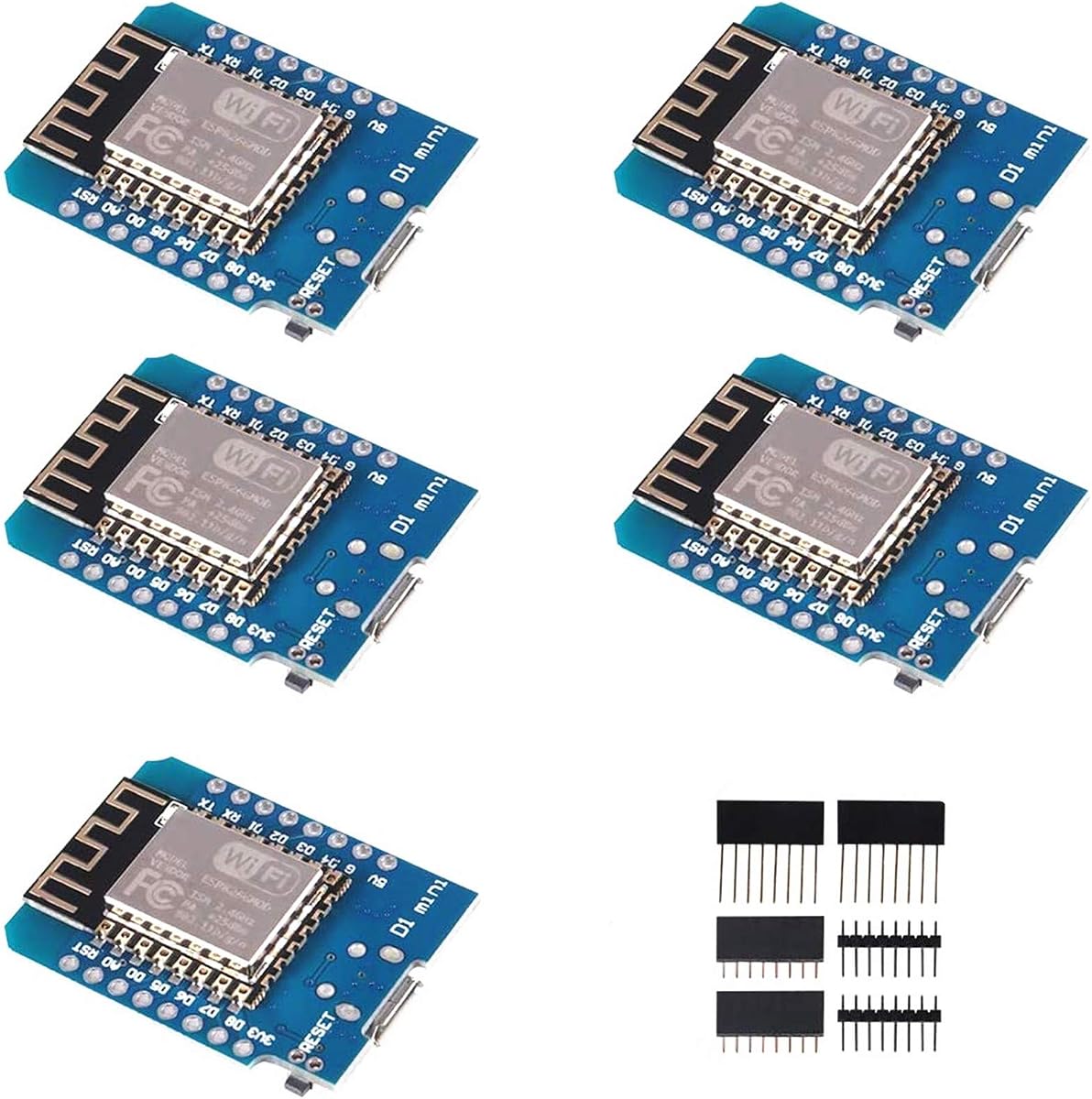
The ESP8266 ESP-12F (5-Pack) delivers a compact development platform rated 4.5 for usability. With Micro USB and 11 GPIO pins, it offers more flexibility than ESP-01 modules. It is ideal for wearable electronics, smart home devices, and small IoT nodes.
We may earn a commission when you buy through this link, at no additional cost to you.
Each unit includes onboard power supply and supports Lua or Arduino IDE. The 4MB flash allows rich features. Its D1 Mini size simplifies integration. While Micro USB is older, it is widely supported and convenient for most users.
Powering from 5V requires care to avoid damage to logic lines. The size may be too small for large prototyping. However, it balances performance and size perfectly for embedded wireless projects.
Anyone seeking compact development with more pins will find this board excellent. For wearable or space-constrained projects, the D1 Mini offers great utility.
With 11 digital pins, you can connect more peripherals than standard ESP-01 modules.
Onboard voltage regulation simplifies wiring and reduces external components.
We may earn a commission when you buy through this link, at no additional cost to you.
This 10-pack offers unmatched value for large projects. Rated 5.0, it provides ten consistent units ideal for networked environments. With AP, STA, and combined modes, it supports diverse application needs. Its compact size fits easily into custom designs.
We may earn a commission when you buy through this link, at no additional cost to you.
The modules deliver efficient execution of complex wireless tasks. With strong signal and reliable data retention, they handle continuous operation well. For bulk deployments, this pack reduces costs and simplifies procurement compared to single purchases.
You must supply power and program through serial adapters. It lacks onboard USB. Still, for cost-conscious developers needing many modules, this bundle is unmatched. It supports industrial and large-scale IoT builds.
If you need many units at the lowest price, this pack is the smart choice. For large-scale projects or classroom use, it offers excellent flexibility and reliability.
Buying in bulk significantly lowers cost per unit, ideal for extensive deployments.
All standard WiFi modes allow seamless integration into diverse network topologies.
We may earn a commission when you buy through this link, at no additional cost to you.
Choosing the right module depends on your project requirements, budget, and technical comfort. Here are key factors to consider before purchasing.
Ensure the module supports the wireless standards you need, such as Wi-Fi 5.0 or Bluetooth 4.2. Some boards include both, while others focus on Wi-Fi only. Check if you need dual-band or mesh support for your environment.
Verify connectivity protocols match your application to avoid compatibility issues during development.
Consider the microcontroller speed and cores. Dual-core boards like ESP32 handle complex tasks better than ESP8266. For AI or real-time control, choose higher MHz options. Simple sensors need less power.
Processing power dictates what your module can handle in complex IoT workflows.
Many modules require 3.3V power and may need external regulators. Boards with USB-C simplify power delivery. Check if you have stable power sources for your setup. Battery projects benefit from low-power modes.
Power compatibility ensures your system runs safely and efficiently without extra components.
Compact modules suit wearable or small devices. Full boards offer more pins but take space. Decide whether you need a standalone module or a development board with headers. Smaller sizes help with tight enclosures.
Size determines where and how easily you can integrate the module into your project.
Some boards work directly in Arduino IDE. Others require MicroPython or Lua. Check compatibility with your preferred language and IDE. Official Arduino boards usually simplify setup. Community support helps resolve errors.
Choose a platform aligned with your coding skills for smoother development.
Flash memory impacts how large your code can be. 4MB is standard on modern modules, while some have 1MB. More storage lets you add features. If using OTA, ensure memory is sufficient for new firmware updates.
Sufficient memory prevents overflow issues during project growth.
Buying in packs reduces cost. For prototypes, one board is fine. Production needs bulk units. Balance cost with required features. Premium boards offer more but cost more. Budget modules work well for basic needs.
Consider pack sizes for cost efficiency depending on your project scale.
Signal strength varies by model. Some have integrated antennas; others require external ones. For long-range IoT, choose modules with stronger RF. Indoor setups may need less. Check for certification to ensure compliance.
Antenna quality impacts how far and reliably your device communicates with other nodes.
Always use the correct voltage to prevent damage. Most ESP modules need 3.3V. Check datasheets before wiring. Use level shifters if connecting 5V devices to GPIO pins.
Secure your module physically with proper mounts or enclosures. Avoid exposing pins to static or moisture. This extends lifespan and prevents connection issues.
Update firmware regularly using OTA features if available. Check documentation for IDE settings and libraries. Keep your project files backed up for easy recovery during changes.
Beginners often benefit from the Arduino UNO R4 WiFi due to official support and easy plug-and-play features. It includes integrated LED feedback and modern USB-C connectivity that simplify setup. For those seeking a budget option, the ESP8266 ESP-01 is popular but requires more wiring.
Yes, most modules support Arduino IDE. You may need to install specific board manager URLs for ESP32 or ESP8266. Boards like UNO R4 are natively supported. Always select the correct board in tools settings.
Some boards like ESP32 and UNO R4 support both Wi-Fi and Bluetooth. ESP8266 modules are Wi-Fi only. Check specs carefully before purchasing. Dual wireless enables more versatile project designs.
Most modules require a stable 3.3V supply. Some boards include onboard regulators. Avoid connecting 5V directly to GPIO pins. Use USB power for development or a regulated supply for permanent installations.
Install the ESP32 board manager in Arduino IDE. Connect via USB-C or serial port. Select the correct board and COM port. Upload the sketch normally. Libraries for WiFi are included.
ESP32 boards offer low-power sleep modes ideal for battery use. ESP8266 has limited power management. For extended runtime, choose boards with efficient power-saving features.
ESP32 and some UNO R4 boards support OTA updates. Configure OTA libraries to push firmware changes remotely. This is useful for deployed devices without physical access.
Use GPIO pins for digital sensors and ADC for analog ones. For I2C, connect SDA and SCL. Ensure voltage levels match. Libraries simplify communication. Refer to pin maps for correct wiring.
Each module offers unique strengths depending on your needs. The UNO R4 leads in performance, ESP32 boards excel in dual connectivity, and ESP8266 packs deliver value for simple tasks. Select based on processing, connectivity, and budget.
Prioritize connectivity and power compatibility. Boards like Nano ESP32 offer modern features, while older modules suit tight budgets. Consider future scalability and support when choosing.
Prices and stock change frequently. Always check current listings for the best availability. Whether you build home automation or industrial sensors, the right module will power your project successfully.