
HiLetgo 5pcs DHT11
4.5Editor score
Wide voltage range support
Simple single wire protocol
Includes five sensor modules
This guide compares the top Arduino temperature sensors for accuracy and range to help you choose the best module for your specific project.
Arduino temperature sensors are essential components for any DIY electronics project involving climate monitoring or thermal control. Choosing the right one ensures your system responds accurately to environmental changes without unnecessary complexity or cost.
We evaluated ten leading models based on accuracy, range, ease of use, and community support. Each option offers unique strengths for hobbyists and professionals seeking reliable data from their microcontroller setups.
Every pick below highlights key specifications and ideal use cases to streamline your selection. Remember that prices fluctuate regularly, so check current listings before finalizing your purchase.
4.5Editor score

4.7Editor score

4.9Editor score
Here is a side-by-side look at the key specifications and features of all ten selected models to help you decide quickly.




This set of five modules offers the most cost-effective way to start monitoring temperature and humidity with your Arduino. It carries a solid rating of 4.5 stars from users who value simplicity and value for money in their projects.
We may earn a commission when you buy through this link, at no additional cost to you.
The DHT11 sensor inside provides a digital output that is easy to read with standard Arduino libraries. Its single-wire scheme reduces wiring complexity significantly, while the onboard capacitor and resistor ensure stable communication without extra components.
While the measurement range tops out at fifty degrees Celsius and accuracy is lower than premium options, these limits are acceptable for basic indoor climate monitoring or simple DIY automation tasks where extreme precision is not required.
Hobbyists needing multiple sensors for distributed monitoring will appreciate the five-pack bundle. It eliminates the need to buy additional units later and provides everything needed to begin experimenting immediately.
The single-wire digital bus simplifies connections to microcontroller pins.
Receiving five sensors lets you cover multiple zones or backup needs.
We may earn a commission when you buy through this link, at no additional cost to you.
The AHT30 stands out as a highly accurate sensor with perfect user ratings. It delivers precise readings with minimal error, making it suitable for projects where reliable data is critical for decision making or control loops.
We may earn a commission when you buy through this link, at no additional cost to you.
Its I2C communication protocol allows multiple sensors to share the same bus lines efficiently. The voltage range spans from two to five point five volts ensuring compatibility with a wide array of microcontrollers without additional regulation.
While the package includes only two units compared to other multi-packs, the quality justifies the count. The four-pin connection design streamlines setup and reduces the chance of wiring errors during initial prototyping.
If your project demands better precision than the DHT11 offers, this module provides a significant upgrade. It is ideal for weather stations, greenhouses, or any application requiring detailed environmental tracking.
Temperature accuracy of plus or minus zero point three Celsius ensures reliable data.
I2C interface enables adding more sensors without complex wiring.
We may earn a commission when you buy through this link, at no additional cost to you.
The SHT31 offers industrial-grade performance with a broad temperature range extending to one hundred twenty five degrees Celsius. Its 4.7 rating reflects strong user satisfaction with the balance of performance and versatility across various projects.
We may earn a commission when you buy through this link, at no additional cost to you.
Operating between two point four and five point five volts gives flexibility for different power sources. The I2C output simplifies connections while maintaining robust communication even in electrically noisy environments.
Accuracy remains tight with humidity readings within two percent and temperature within zero point three degrees. This level of precision makes it suitable for professional or semi-professional setups where stability is paramount.
For users needing more than two sensors, the three-pack provides a practical compromise. It is excellent for large scale monitoring where cost per unit still matters but quality cannot be compromised.
Operating from minus forty to one hundred twenty five Celsius covers diverse environments.
I2C ensures reliable data transfer even with multiple devices on the bus.
We may earn a commission when you buy through this link, at no additional cost to you.
This DS18B20 sensor set is designed for environments where water exposure is likely. Users appreciate the long meter cable and included adapter module that simplifies wiring into your Arduino or other microcontroller boards.
We may earn a commission when you buy through this link, at no additional cost to you.
The waterproof probe allows placement in fish tanks, greenhouses, or outdoor weather stations without risk of damage. The onboard pull-up resistor eliminates the need for external components making setup cleaner and faster.
With a range of minus fifty five to one hundred twenty five degrees Celsius it handles extreme conditions well. The digital output ensures clean signals even over the one meter cable distance.
Three sets give enough flexibility for multi-point monitoring in large spaces. If you need waterproof sensing capability this package delivers reliability and convenience at a competitive price point.
Sealed probe withstands wet or corrosive environments safely.
Adapter board with resistor reduces assembly steps significantly.
We may earn a commission when you buy through this link, at no additional cost to you.
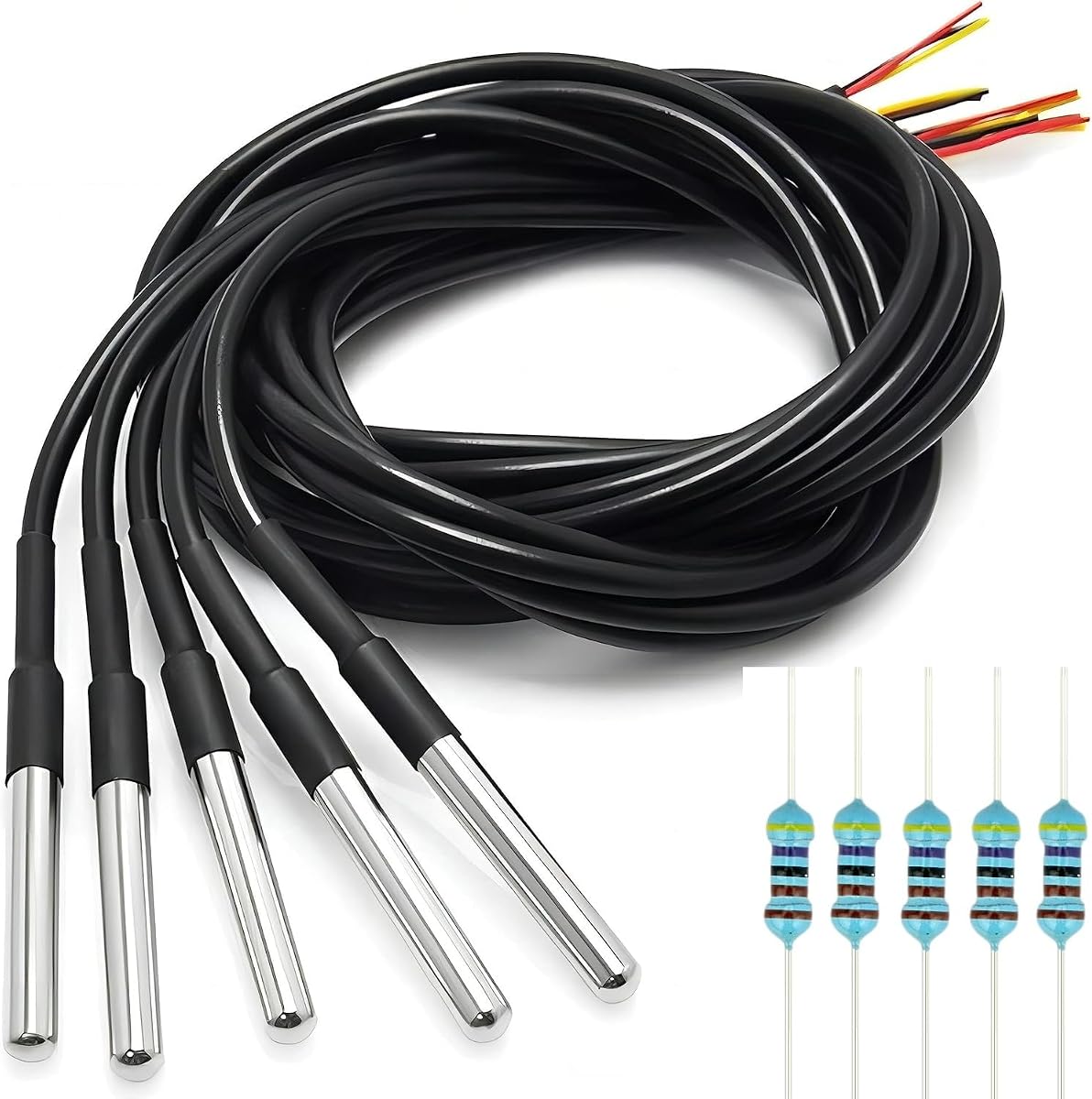
If you need to monitor five distinct zones this five-pack is hard to beat. It provides enough probes and resistors to build a comprehensive distributed temperature network without additional purchases or trips to a store.
We may earn a commission when you buy through this link, at no additional cost to you.
The DS18B20 sensor itself is known for robust digital output and water resistance. Each probe connects via three wires which are color coded for clarity and ease of installation into your circuit.
While adapter boards are not included the resistors are supplied to ensure proper 1-wire communication. This setup suits users comfortable with basic soldering or breadboard prototyping where flexibility is valued.
The wide voltage and temperature compatibility means it works across many projects. For budget conscious buyers needing multiple waterproof units this option offers excellent value and coverage.
Resistors included simplify initial testing without extra components.
Five sensors allow tracking temperature across large or complex areas.
We may earn a commission when you buy through this link, at no additional cost to you.
This compact two-pack delivers the essential functionality needed for basic indoor sensing projects. Users praise its stability and straightforward integration into standard Arduino sketches without complex libraries.
We may earn a commission when you buy through this link, at no additional cost to you.
The digital output ensures that the microcontroller reads data without noise interference. This makes the sensor reliable for long-term deployment in environments like homes or offices.
With a voltage range of three point three to five volts it fits well with most development boards. The included wires help you start prototyping immediately without sourcing extra connectors.
For smaller projects where only two measurement points are needed this is sufficient. It provides a low cost entry point for those who prefer proven reliability over cutting-edge precision.
Long term stability ensures consistent readings over months of use.
Includes wires so you can connect right out of the box.
We may earn a commission when you buy through this link, at no additional cost to you.
This kit stands out for including nearly everything you need to start measuring temperature quickly. The combination of probes, adapters, wires, and resistors simplifies the setup process significantly for beginners.
We may earn a commission when you buy through this link, at no additional cost to you.
The stainless steel housing provides durability against rust and corrosion making it ideal for harsh conditions. Its waterproof seal allows for direct submersion in liquids without damage over time.
Users report high accuracy and fast response times thanks to the quality construction. The adapter board with pull-up resistor ensures clean data on the 1-wire bus for reliable readings.
If you want a ready-to-use solution without buying accessories separately this is excellent. It balances price with completeness to offer a seamless experience for DIY electronics builders.
All needed components are included for immediate deployment.
Stainless steel casing protects against moisture and corrosion.
We may earn a commission when you buy through this link, at no additional cost to you.
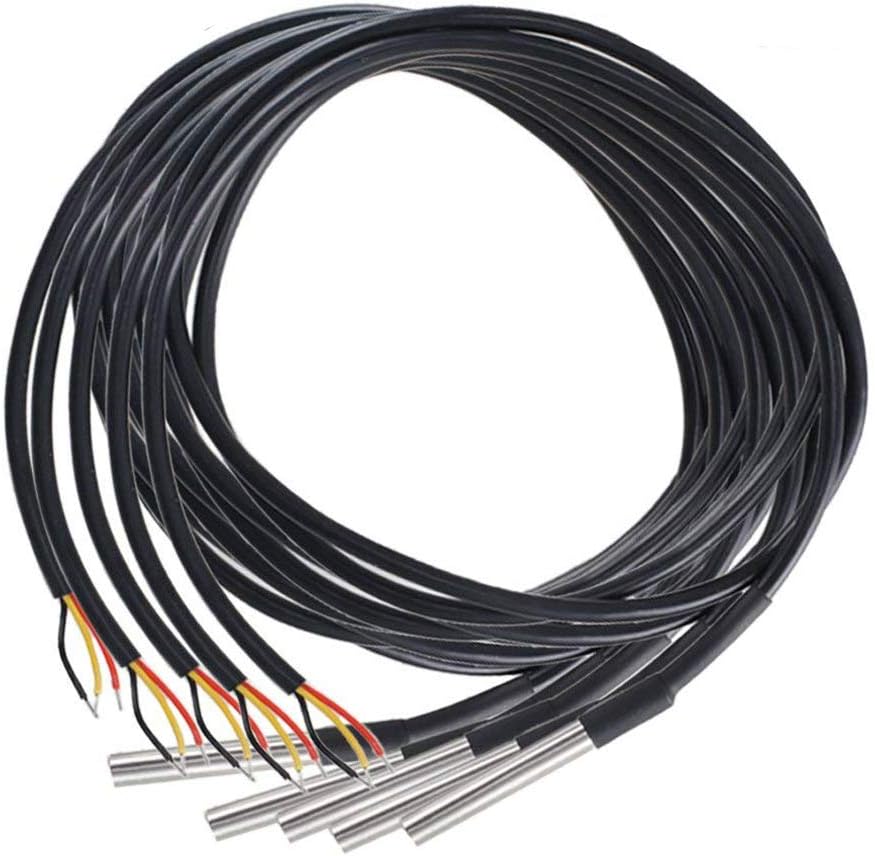
When distance matters this five-pack gives you a full meter of cable per sensor. This allows you to place probes far from your Arduino without needing extra wire splicing.
We may earn a commission when you buy through this link, at no additional cost to you.
The single bus interface supports daisy-chaining multiple sensors on one pin. This reduces the number of pins required and keeps your wiring neat even with multiple zones.
Waterproof packaging ensures the probes can be safely used outdoors or in wet containers. The digital thermal probe is robust enough to handle typical DIY temperature ranges.
Five sensors provide ample coverage for most home or workshop projects. While it lacks adapter boards the resistors are easy to add if needed for stable operation.
One meter leads allow remote placement of temperature probes.
Single wire communication saves valuable microcontroller input pins.
We may earn a commission when you buy through this link, at no additional cost to you.
The DHT22 offers an upgrade in accuracy over the basic DHT11 model. It is perfect for projects where half degree precision makes a difference for your application logic.
We may earn a commission when you buy through this link, at no additional cost to you.
Operating between minus forty and eighty degrees Celsius covers most indoor climate needs. The single bus output remains easy to use with standard libraries and protocols.
Fixing holes on the module make it easier to mount securely in enclosures. This physical design feature helps prevent vibration or movement during operation.
Two units allow you to monitor two distinct zones without extra cost. It is a solid choice for more advanced DIY users who need better data resolution.
Half degree temperature accuracy improves project reliability.
Screw holes allow secure installation in enclosures.
We may earn a commission when you buy through this link, at no additional cost to you.
This five-pack provides a robust solution for large scale monitoring with durable probes. The stainless steel casing ensures the sensors survive in demanding environments without degradation.
We may earn a commission when you buy through this link, at no additional cost to you.
Each probe is one meter long allowing remote placement away from electronics. The wide voltage range makes it compatible with virtually any microcontroller board in your collection.
Waterproof capabilities enable submersion in liquids for aquariums or industrial tanks. This versatility ensures the same sensor can be used across different types of projects.
Five sensors at this price point deliver outstanding value for distributed systems. It is ideal for projects needing multiple robust probes without investing in expensive industrial units.
Steel casing resists rust and physical damage in harsh conditions.
Five units enable monitoring across multiple remote zones.
We may earn a commission when you buy through this link, at no additional cost to you.
Selecting the right sensor depends on your project's specific needs regarding accuracy, environment, and connectivity.
Ensure the sensor covers the minimum and maximum temperatures you expect. Some models start at zero while others support extreme cold down to minus forty or fifty five degrees.
Pick a model that exceeds your expected operating range for safety and reliability.
Precision matters in critical systems like incubators or industrial controls. Look for sensors with accuracy ratings under one degree for professional grade performance.
Higher accuracy ensures your automation logic makes correct decisions based on real data.
Most sensors use digital buses like I2C or 1-wire to simplify wiring. I2C supports more devices but requires two data lines while 1-wire uses just one.
Choose the interface that best fits your microcontroller pin availability and complexity tolerance.
If your project involves liquids or outdoor exposure verify the sensor is waterproof. Stainless steel probes offer better durability than plastic encased modules.
Waterproof units prevent electrical shorts and ensure longevity in humid environments.
Check that the sensor works with your board's supply voltage such as 3.3V or 5V. Wide voltage support reduces the need for regulators or level shifters.
Compatible voltage ensures stable operation without additional power circuitry.
Longer cables provide flexibility to place sensors away from the main board. Some modules come with one meter wires while others may require you to solder your own.
Sufficient length avoids clutter near sensitive electronics and improves safety.
If you need multiple readings in different locations consider packs with several units. Some sensors allow daisy-chaining which saves microcontroller pins significantly.
Daisy-chaining capabilities reduce wiring complexity when monitoring large areas.
Some kits include adapters resistors or jumper wires to simplify setup. Missing components may require extra purchases before you can begin.
Check the contents to ensure you have everything needed for immediate deployment.
Begin by checking the datasheet for voltage requirements and pin connections. Match the VCC GND and DATA wires to the corresponding pins on your microcontroller.
Install the appropriate library for your sensor model in the Arduino IDE. This step ensures you have the correct functions to read data accurately.
Test the setup with a basic sketch before final assembly. Monitor the output to confirm the readings are stable and match expected values.
The AHT30 and SHT31 models are among the most accurate with temperature precision within 0.3 degrees Celsius. They are ideal for projects requiring high data reliability.
Yes but you must select a waterproof model with a protective housing like the DS18B20 stainless steel probes. Ensure the package is rated for environmental exposure to avoid damage.
Some modules include pull-up resistors on board while others require external ones. Check the product description to see if resistors are needed for your specific model.
For I2C sensors connect all SDA and SCL lines together. For 1-wire sensors daisy-chain the data pins on a single bus to save microcontroller inputs.
The DHT11 or DHT22 are great starters due to simple libraries and wiring. They work well for indoor temperature and humidity monitoring tasks.
Yes waterproof probes like the DS18B20 can measure water temperature safely. Ensure the probe is sealed properly to prevent water from entering the electronics.
Most digital sensors respond within a few seconds to temperature changes. Precise readings may require a short delay after power up or state changes.
Yes all listed sensors are compatible with ESP32 and ESP8266 boards. Verify the voltage compatibility and use appropriate pull-up resistors for best results.
We reviewed ten top models ranging from affordable DHT11 packs to precision SHT31 sensors. Each option balances cost accuracy and features to suit different project needs.
Prioritize accuracy and waterproofing if your environment is extreme. For simple indoor tasks budget friendly modules provide excellent value without sacrificing reliability.
Check current prices and availability before purchasing since stock fluctuates regularly. Select the sensor that aligns best with your technical requirements and timeline.