This guide compares the top Arduino ADC Board options for precision sensing, covering resolution, channels, and compatibility to help you choose the right
As an Amazon Associate we earn from qualifying purchases. We may earn a commission when you buy through links on this page, at no additional cost to you. Read our affiliate disclosure.As an Amazon Associate we earn from qualifying purchases.Purchases through our links may earn us a commission, at no extra cost to you. Read our affiliate disclosure.
An Arduino ADC Board is essential for reading analog signals like voltage or sensor data into digital microcontrollers. These modules bridge the gap between real-world analog inputs and the digital logic of boards like the Arduino Uno or Raspberry Pi. Choosing the right one depends on resolution, channel count, and interface type.
We evaluated ten top-rated ADC modules based on precision, build quality, ease of integration, and user feedback. Our analysis focused on key features like bit resolution, sampling rates, and compatibility with common development environments. This list ensures you find a reliable solution for your specific data acquisition needs.
Each pick highlights unique strengths, from budget-friendly 16-bit converters to high-speed multi-channel units. While prices fluctuate, these models consistently deliver accurate performance for robotics, IoT, and industrial monitoring. Always check current listings for the best value before purchasing your next project component.
Top 3 Picks for Best Arduino ADC Board
Best Budget
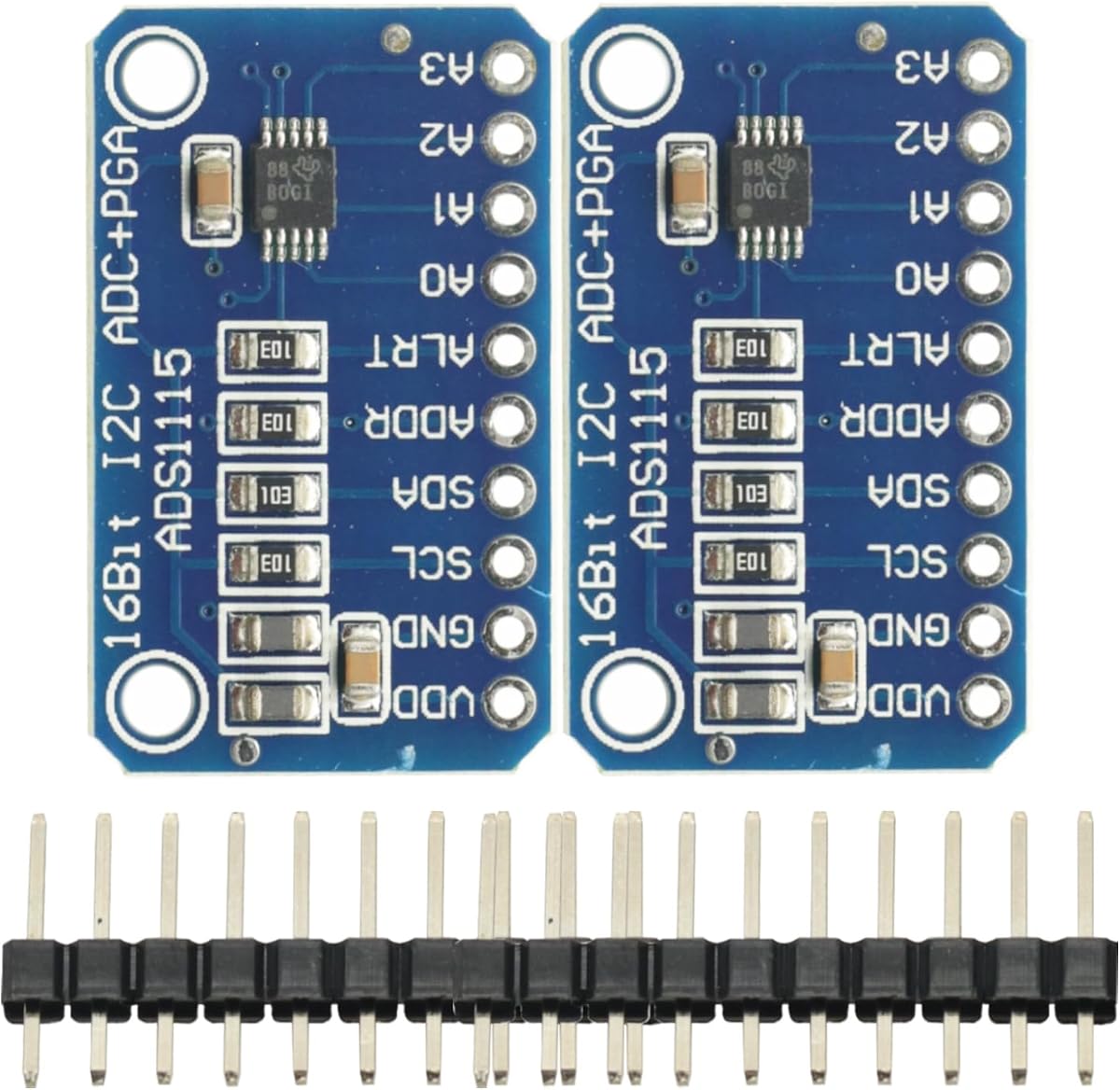
2Pcs ADS1115 16 Bit I2C Module Precision ADC 4 Channel Analog-to-Digital Converter Development Board Pro Gain Amplifier for Arduino Raspberry Pi ADC Module
This table provides a side-by-side comparison of all ten selected ADC modules. It highlights critical specifications such as resolution, channel count, communication interface, and key features to help you quickly identify the best fit for your project requirements.
ProductsSpecificationsEditor scorePrice
1
Editor's Choice
Teyleten Robot ADS1115 16 Bits 4 Channel Analog-to-Digital Converter Precised Develop Board Module Amplifier Board ADC I2C IIC for Arduino Raspberry Pi (Pack of 3pcs)
2Pcs ADS1115 16 Bit I2C Module Precision ADC 4 Channel Analog-to-Digital Converter Development Board Pro Gain Amplifier for Arduino Raspberry Pi ADC Module
HiLetgo 3pcs ADS1115 16 Bit 16 Byte 4 Channel I2C IIC Analog-to-Digital ADC PGA Converter with Programmable Gain Amplifier High Precision ADC Converter Development Board for Arduino Raspberry Pi
2PCS ADS1115 16 Bit IIC I2C Analog to Digital Converter Module Precision ADC Converter 4 Channel Development Board Programmable Gain Amplifier 2.0V to 5.5V for Arduino Raspberry Pi
HiLetgo ADS1115 16 Bit 16 Byte 4 Channel I2C IIC Analog-to-Digital ADC PGA Converter with Programmable Gain Amplifier High Precision ADC Converter Development Board for Arduino Raspberry Pi
Teyleten Robot ADS1115 16 Bits 4 Channel Analog-to-Digital Converter Precised Develop Board Module Amplifier Board ADC I2C IIC for Arduino Raspberry Pi (Pack of 3pcs)
16-bit resolution
4 channels
I2C interface
860 SPS
This Teyleten Robot module offers excellent value with its 16-bit resolution and 4-channel input. It is rated highly by users for its reliability in precision sensing tasks. The built-in Programmable Gain Amplifier makes it suitable for reading low-voltage sensors accurately.
Pros
High precision 16-bit conversion
Includes PGA for small signals
Wide voltage supply range
Multiple pack options available
Compatible with many platforms
Cons
Limited to I2C only
Requires external libraries
We may earn a commission when you buy through this link, at no additional cost to you.
The ADS1115 chip provides a wide voltage supply range from 2.0V to 5.5V. This flexibility allows it to work seamlessly with both 3.3V and 5V microcontrollers. The I2C interface simplifies wiring compared to SPI or parallel alternatives.
While it lacks the speed of higher-end ADCs, its sampling rate of up to 860 samples per second is sufficient for most stationary sensor applications. The only trade-off is the need for specific software libraries to interface with the module.
This board is ideal for hobbyists and professionals needing accurate analog-to-digital conversion without complex hardware. It is highly recommended for data logging, sensor monitoring, and educational projects requiring multiple inputs.
Precision Sensing Capabilities
The 16-bit resolution ensures that even minute voltage changes are captured with high fidelity. This is crucial for applications involving temperature sensors or strain gauges where small fluctuations matter.
Programmable Gain Amplifier
The internal PGA allows you to adjust the input range to match your sensor output. This feature maximizes the resolution available for small signals without needing external amplification circuitry.
HiLetgo ADS1256 5V 8 Channel 24 Bit ADC Data Acquisition Board Module High Precision AD Collecting Data Acquisition Card
24-bit resolution
8 channels
SPI interface
Reference voltage
The HiLetgo ADS1256 stands out for its exceptional 24-bit resolution, making it perfect for highly sensitive measurements. It is designed for users who need to capture extremely small voltage changes. The onboard ADR03 voltage reference ensures consistent accuracy.
Pros
Ultra high 24-bit resolution
8 channel input support
On-board reference voltage chip
Low nonlinearity
Configurable inputs
Cons
Complex SPI wiring
Higher power consumption
We may earn a commission when you buy through this link, at no additional cost to you.
With 8 channels and configurable differential inputs, this module offers significant versatility. It supports data output rates up to 30ksps, which is faster than many 16-bit alternatives. The SPI interface allows for high-speed data transfer.
However, the SPI protocol requires more pins on your microcontroller compared to I2C. Additionally, the precision comes with a slightly higher price point. It is best suited for applications where resolution is more critical than pin simplicity.
Choose this module if you are building a high-precision data logger or industrial monitoring system. It excels in environments where signal integrity and fine detail are paramount for successful project outcomes.
Superior Resolution
The 24-bit resolution provides a dynamic range that captures details invisible to standard 10-bit or 12-bit ADCs. This is essential for scientific instruments and high-fidelity sensor networks.
Reference Voltage Accuracy
The onboard ADR03 chip provides a stable 2.5V datum voltage source. This minimizes errors caused by fluctuating power supplies, ensuring your readings remain accurate over time.
2Pcs ADS1115 16 Bit I2C Module Precision ADC 4 Channel Analog-to-Digital Converter Development Board Pro Gain Amplifier for Arduino Raspberry Pi ADC Module
16-bit resolution
4 channels
I2C interface
Programmable gain
This 2-pack of ADS1115 modules offers an incredible value for hobbyists. It carries a perfect 5.0 rating based on user satisfaction with performance and price. Each board provides the standard 16-bit resolution and 4-channel input.
Pros
Affordable 2-pack bundle
Perfect 5.0 rating
I2C simplicity
Wide input ranges
Compatible with Raspberry Pi
Cons
Basic header connections
Manual assembly needed
We may earn a commission when you buy through this link, at no additional cost to you.
The I2C interface means you only need two wires for communication. This makes it ideal for projects where pin space is limited. The programmable data rate allows you to balance speed and power consumption effectively.
While the packaging is basic, the functionality is identical to more expensive brands. The only downside is that headers may need soldering depending on the specific kit. This is a minor trade-off for the cost savings.
This pack is recommended for those building multiple projects or needing redundancy in sensor arrays. It proves that high-precision data acquisition does not have to be expensive for the average maker.
Cost-Effective Precision
Buying in a 2-pack reduces the per-unit cost significantly compared to single modules. This allows you to deploy multiple sensors across a large area without breaking your budget constraints.
Raspberry Pi Support
Since Raspberry Pi lacks analog GPIO pins, this module bridges that gap efficiently. It works seamlessly with Pi's GPIO headers using standard I2C protocols for easy integration.
HiLetgo 3pcs ADS1115 16 Bit 16 Byte 4 Channel I2C IIC Analog-to-Digital ADC PGA Converter with Programmable Gain Amplifier High Precision ADC Converter Development Board for Arduino Raspberry Pi
16-bit resolution
4 channels
I2C interface
Comparator mode
HiLetgo provides a 3-pack of ADS1115 modules that is excellent for classroom or studio environments. The 16-bit precision and 4 channels offer a great balance for general electronics projects. It supports both 3.3V and 5V systems.
Pros
Three unit bundle
High voltage supply range
Comparator mode feature
Wide platform compatibility
Simple I2C wiring
Cons
Variable user feedback
Requires specific libraries
We may earn a commission when you buy through this link, at no additional cost to you.
The comparator mode feature allows the board to signal when a threshold is exceeded without constant polling. This saves processing power on your microcontroller. The single-shot mode also helps in reducing power consumption.
Some users report variability in quality control compared to single units. The 4.3 rating reflects that while most work well, some may need testing before use. However, the price per unit remains competitive.
This bundle is perfect for educators or makers working on simultaneous prototyping. It ensures you have spares on hand, reducing downtime if a module fails during a complex wiring setup.
Comparator Mode Benefits
Comparator mode lets the ADC trigger an interrupt when a voltage threshold is crossed. This is useful for alarm systems or safety monitoring where immediate reaction to a signal change is needed.
Single-Shot Power Efficiency
The single-shot mode automatically shuts down after a conversion. This conserves battery life in portable projects where continuous sampling is not required for every cycle.
This 4-piece set of ADS1115 boards is designed for large-scale deployments. It offers the standard 16-bit resolution and 4-channel capability found in most high-quality modules. The wide voltage supply range ensures compatibility with various power sources.
Pros
Four unit bulk pack
Wide voltage supply range
Internal oscillator included
Multiple input ranges
Affordable entry point
Cons
Mixed quality reports
No specific branding
We may earn a commission when you buy through this link, at no additional cost to you.
The internal oscillator provides stability for timing-sensitive applications. You can also select from multiple input ranges to match your sensor requirements. This flexibility is key when working with diverse signal types.
User ratings are mixed due to the bulk nature of the kit. Some units may not be pre-tested, so checking connections before installation is advised. The cost efficiency, however, makes it a viable option for large projects.
Consider this pack for IoT monitoring nodes or classroom labs where you need many identical boards. It is a practical choice when budget is a primary constraint and quantity is more important than packaging.
Internal Oscillator Stability
The built-in oscillator ensures precise timing for data sampling without external components. This helps maintain consistency in data logging intervals even if the power supply fluctuates.
Multiple Input Ranges
Selecting the right input range improves accuracy for different sensor voltages. You can configure the board to measure small voltages with high resolution or larger voltages with wider range.
2PCS ADS1115 16 Bit IIC I2C Analog to Digital Converter Module Precision ADC Converter 4 Channel Development Board Programmable Gain Amplifier 2.0V to 5.5V for Arduino Raspberry Pi
16-bit resolution
4 channels
I2C interface
Programmable gain
This 2-pack features a perfect 5.0 rating, indicating strong user satisfaction with its performance. It supports a wide voltage range, making it suitable for both battery-powered and mains projects. The 16-bit resolution captures fine detail effectively.
Pros
Perfect 5.0 user rating
2.0V to 5.5V supply
I2C interface
Programmable gain amplifier
Low power consumption
Cons
Requires soldering headers
Basic packaging
We may earn a commission when you buy through this link, at no additional cost to you.
The programmable gain amplifier (PGA) allows you to adjust the sensitivity of the inputs. This is especially useful when measuring signals that vary significantly in magnitude. You can switch ranges dynamically to optimize resolution.
While the physical form is standard, the electrical performance is robust. Users appreciate the reliability in data acquisition tasks. The only minor inconvenience is that headers may need to be soldered before use.
This module is highly recommended for students and developers building reliable sensor interfaces. It combines simplicity of the I2C protocol with the power of programmable gain for versatile applications.
Wide Voltage Support
Operating between 2.0V and 5.5V means this board works with a variety of power sources. You can run it off a simple AA battery pack or a standard USB 5V supply without issue.
Programmable Gain Amplifier
The PGA adjusts the internal gain to match your input signal. This ensures you get the best possible signal-to-noise ratio regardless of the voltage level you are measuring.
Lonely Binary 3-Pack ADS1115 16-Bit ADC I2C Module for C++ & ESP32
16-bit precision
4 channels
I2C interface
ENIG finish
Lonely Binary offers a premium take on the ADS1115 with ENIG plating and open-source support. This ensures better solderability and oxidation resistance compared to standard boards. It is designed for C++ and ESP32 ecosystems specifically.
Pros
ENIG plating finish
Lead-free construction
Addresses for chaining
Works with ESP32
Open-source friendly
Cons
Higher unit cost
Specific library support
We may earn a commission when you buy through this link, at no additional cost to you.
The module supports chaining up to four boards on the same I2C bus. This gives you up to 16 analog channels without complex routing. Each module has a selectable address to prevent conflicts.
The build quality is robust, making it ideal for long-term installations. The lead-free RoHS-compliant construction adds to its safety and reliability. While it costs more, the durability is worth it for professional builds.
Select this option for projects that demand high reliability and clean signal paths. It is particularly well-suited for educational labs and makers who value open-source documentation and ethical manufacturing.
ENIG Finish Reliability
Electroless Nickel Immersion Gold plating improves contact longevity and reduces oxidation. This is crucial for modules that will be connected and disconnected frequently during prototyping or maintenance.
Multi-Module Chaining
With selectable addresses, you can stack up to four modules on one bus. This scales your input channels effortlessly while keeping your wiring layout clean and organized.
Teyleten Robot AD7606 Module Multi-Channel AD Data Acquisition Module 16-bit ADC 8-Channel Synchronization Sampling Frequency 200KHz
16-bit resolution
8 channels
SPI interface
200kHz sampling
The AD7606 module stands out with its 200kHz sampling rate, which is significantly faster than standard ADCs. It supports 8-channel synchronous sampling, making it suitable for audio or vibration analysis. The input range is also more flexible.
Pros
200kHz sampling rate
8 synchronized channels
±5V or ±10V input
Internal reference voltage
Parallel data output
Cons
Requires complex wiring
Lower user ratings
We may earn a commission when you buy through this link, at no additional cost to you.
It operates on a 5V supply and offers a robust 2.5V internal reference. The SPI interface allows for rapid data transfer, though it requires more control lines. This module targets users needing fast, simultaneous measurements.
User feedback suggests it may be more complex to integrate for beginners. Proper timing and clocking are essential for correct data acquisition. It is not as plug-and-play as I2C modules but offers higher throughput.
Choose this module if you need to capture high-frequency signals like sound waves or motor vibrations. It is a specialized tool for industrial or engineering projects where speed is the primary priority.
Synchronous Sampling
All eight channels sample at exactly the same time. This prevents phase shifts between signals, which is critical when analyzing relationships between multiple analog inputs.
200kHz Sampling Rate
A sampling rate of 200kHz allows for accurate reconstruction of fast-moving signals. This is essential for real-time monitoring and capturing transient events in electrical or mechanical systems.
This 4-pack offers reliable 16-bit conversion at a competitive price point. It is designed for easy integration with popular microcontrollers like ESP32 and Raspberry Pi. The 4-channel layout covers most standard data logging needs.
Pros
4-pack value
High precision conversion
Simple wiring
Compatible with ESP32
Good for sensors
Cons
Limited to I2C
Requires external pull-ups
We may earn a commission when you buy through this link, at no additional cost to you.
The I2C interface ensures simple wiring with just two data lines. It is ideal for reading temperature, pressure, and light sensors. The high precision ensures your logged data is accurate and stable over time.
Users appreciate its simplicity and broad compatibility. The main limitation is the need for external pull-up resistors on the I2C lines if not present on your host board. This is a minor requirement for most projects.
This bundle is excellent for building sensor arrays or environmental monitors. It provides enough units to prototype multiple locations or share with peers without requiring additional hardware costs.
Sensor Compatibility
Designed specifically for common sensors like thermistors and piezoelectric transducers. This ensures that your project can easily interface with a wide range of off-the-shelf components.
Easy Integration
The module works out-of-the-box with popular libraries like Adafruit. This reduces the development time significantly, allowing you to focus on the application logic rather than driver code.
HiLetgo ADS1115 16 Bit 16 Byte 4 Channel I2C IIC Analog-to-Digital ADC PGA Converter with Programmable Gain Amplifier High Precision ADC Converter Development Board for Arduino Raspberry Pi
16-bit resolution
4 channels
I2C interface
Comparator mode
HiLetgo offers a reliable standard version of the ADS1115 with consistent performance. It provides the essential 16-bit resolution and 4-channel input found in most professional setups. The board supports 3.3V to 5V supply voltage.
Pros
Proven 16-bit performance
Programmable gain
I2C communication
Wide supply range
Stable readings
Cons
Basic design
Requires careful handling
We may earn a commission when you buy through this link, at no additional cost to you.
The comparator mode helps in alarm triggers without constant CPU polling. The PGA allows you to adjust for low-voltage signals effectively. It is a dependable choice for general-purpose analog-to-digital conversion.
While the design is simple, it lacks some modern features like onboard protection. Users report it works well with standard libraries. It is a practical option for those who need a straightforward solution.
This module is recommended for basic hobby projects or industrial prototypes. It offers the right balance of performance and cost for most users who do not require specialized features.
Standard Performance
Provides stable 16-bit readings without complex setup requirements. It is a dependable workhorse for everyday electronics projects where reliability is key.
Low-Voltage Adjustment
The programmable gain amplifier adjusts input sensitivity. This ensures you can measure millivolt signals accurately without amplifying noise or losing resolution.
We may earn a commission when you buy through this link, at no additional cost to you.
Buying Guide – How to Choose the Best Arduino ADC Board
Selecting the right Arduino ADC Board involves considering several technical factors that impact performance and ease of use.
Resolution
Resolution determines how many discrete levels the ADC can distinguish within a voltage range. Higher resolution like 24-bit offers better precision for sensitive sensors compared to standard 10-bit or 12-bit inputs. For most applications, 16-bit provides an excellent balance of detail and data size.
Channel Count
The number of input channels determines how many sensors you can connect simultaneously. Modules with 4 channels are standard for most hobby projects, while 8-channel boards suit industrial or multi-sensor logging. Always choose a board that meets your current and future needs to avoid extra costs.
Communication Interface
Interfaces like I2C and SPI affect wiring complexity and speed. I2C uses two wires and is simpler for beginners but slower than SPI. SPI offers faster data transfer but requires more pins. Ensure your microcontroller supports the interface you choose for seamless integration.
Input Voltage Range
The input voltage range defines the maximum and minimum signal the board can read without damage. A wide range ensures compatibility with different sensors and power supplies. Look for boards that support your specific signal range to protect the hardware and maintain accuracy.
Sample Rate
Sample rate is how often the ADC converts the analog signal to digital per second. High sample rates are necessary for capturing fast changes in voltage. For slow sensors like temperature, lower rates are sufficient and save power. Match the rate to your project's dynamics.
Programmable Gain Amplifier
A PGA allows you to adjust the gain of the input signal before conversion. This feature helps in measuring small voltage changes accurately without external hardware. It is particularly useful for thermocouples or low-output sensors that need signal boosting.
Compatibility
Ensure the ADC board works with your specific microcontroller platform. Most support Arduino and Raspberry Pi, but some are optimized for ESP32 or specific libraries. Check documentation to confirm driver availability and voltage compatibility to prevent hardware issues during setup.
Build Quality
High-quality PCB materials and finish ensure longevity and reliable electrical connections. Look for boards with proper shielding and stable reference voltages. Good build quality reduces noise and improves accuracy in your final data readings over the long term.
How to Use and Care for Your Arduino ADC Board
Begin by wiring the power and ground pins correctly to your microcontroller. Connect the communication lines (SDA and SCL for I2C) to the appropriate pins on your board. Ensure the voltage levels match to avoid damage to the ADC or the controller.
Install the necessary library for your microcontroller to communicate with the ADC. Configure the data rate and input range in your code to match your sensor requirements. Test with known voltages to verify accuracy before integrating full sensors.
Store your ADC boards in a dry environment to prevent oxidation of pins. Avoid bending the board excessively when inserting into a breadboard to protect the solder joints. Regularly check connections for wear to maintain consistent signal quality during use.
Frequently Asked Questions
What is the main purpose of an Arduino ADC Board?
An Arduino ADC Board converts continuous analog signals into digital values that the microcontroller can process. This allows you to read sensors like temperature, pressure, or light. It is essential for applications requiring precise measurement of real-world data.
How do I connect an I2C ADC to my Arduino?
Connect the VCC to 3.3V or 5V, GND to ground, SDA to the Arduino SDA pin, and SCL to the Arduino SCL pin. Install the corresponding library in the IDE and use the provided example code to read data. This setup is quick and simple for most users.
Can I use these boards with Raspberry Pi?
Yes, most of these boards are fully compatible with Raspberry Pi due to their I2C or SPI interfaces. Since Raspberry Pi lacks built-in ADCs, these modules are a popular choice. Ensure you enable the I2C or SPI interface in the Raspberry Pi configuration tools.
What resolution do I need for a temperature sensor?
For standard temperature sensors, 16-bit resolution provides more than enough precision. It allows you to detect small changes in heat without overwhelming your storage. Higher resolutions like 24-bit are typically unnecessary unless you are doing industrial-grade scientific measurements.
Why use an ADC module instead of built-in inputs?
Built-in inputs on many boards are low resolution or limited in number. External modules offer higher precision, more channels, and configurable gain. They are also often faster and more reliable for specific applications than generic onboard solutions.
How can I reduce noise in ADC readings?
Noise can be reduced by using a stable power supply and adding decoupling capacitors. Ensure your wiring is shielded and away from high-current lines. You can also average multiple readings in code to smooth out minor fluctuations in the signal.
Final Thoughts on Choosing the Best Arduino ADC Board
We have highlighted the top options for precise and reliable data acquisition. The Teyleten Robot ADS1115 leads as the best overall choice for most users. The HiLetgo ADS1256 offers superior resolution for advanced projects.
Prioritize resolution and channel count based on your specific application. Ensure compatibility with your existing microcontroller ecosystem for smoother integration. Consider the communication interface that best suits your wiring constraints.
Prices may change over time so always verify current listings before purchase. Check user reviews for the latest feedback on quality and performance. With the right choice, you can significantly enhance your project's data accuracy.
Discover the top ANC headphones for watching YouTube in October 2026. We compare noise cancellation, sound quality, battery life, and comfort for immersive
Compare the top AI gimbal with tripod models for 2026 featuring stable tracking stabilization and hands-free filming tools for content creators and vloggers